Little Nicolas
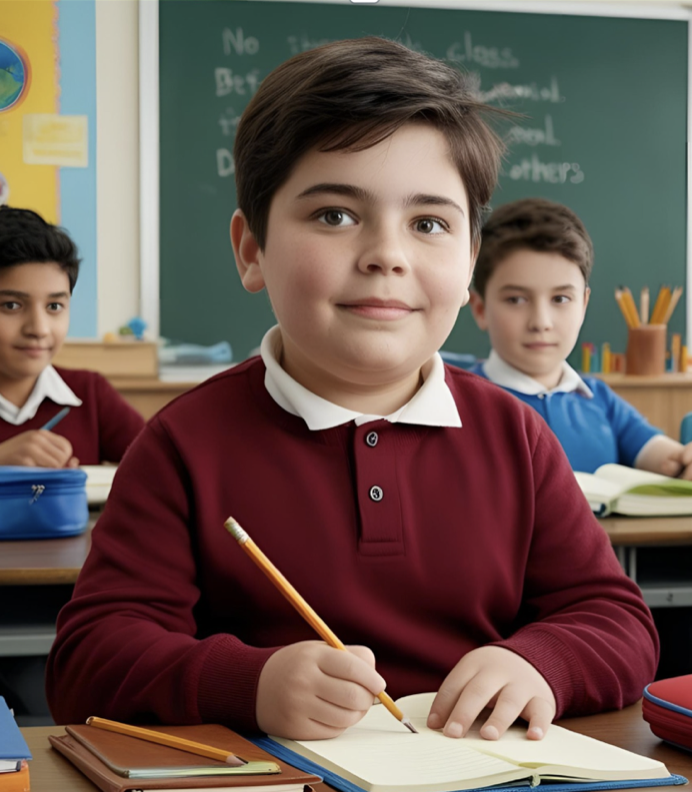
Subjects involved
Student
The student says he is proud of himself and generally relaxed. He likes his body.
In class, he wishes his classmates would appreciate him more, and he feels inadequate compared to them.
About his family, he says he has a wonderful family and that his parents are proud of him, that he is a good son.
Regarding his grades in class, he says he gets good results but would like to be better. He says he feels discouraged when he gets bad results but feels capable of completing his studies. And when he gets good results, he thinks he was lucky and that the teacher asked him what he knew. But when he starts a test in class, he is convinced he can succeed..
Teachers
The student shows no reluctance to come to school, but he is unfocused and likes to play with objects in the classroom, such as his pencil case, and stares out the window. He doesn't listen to what the teachers are saying, so he doesn't know how to respond. He has no sensory difficulties or mental health issues.
In class, he doesn't participate on his own. During group work, he does other things. To get him to participate, he needs a lot of encouragement. He doesn't express himself spontaneously and seems ashamed of his grades.
When it comes to his homework, he only submits work in certain subjects.
He has difficulties with grammar and syntax, and has language problems (German and English).
He doesn't have any conflicts with his classmates or adults, but he is bored in class.He often intervenes to defend his classmates. He is not interested in school subjects. The teachers have provided support with homework and drawing, and it seems to be helping him.
The teachers feel he has difficulty memorizing things and think his slowness is putting him at a disadvantage.
He has no behavioral problems, and he and his parents are willing to commit to a support program.
School leaders
The student doesn't pose any particular problems in terms of behavior at school, in the classroom, with others, or with teachers. He is still very immature and interested in certain subjects. Teachers are concerned because he constantly needs support to complete assigned tasks and achieves low results (except in art subjects). Teachers fear that he will become discouraged.
Counselors
The counselor emphasizes that the student needs constant support to meet the expected performance of a 6th-grade student. Without support from the teaching team, the student risks disengaging completely. The student is a serious student who doesn't cause problems at school. He is conscientious and doesn't truant. In class, he is larger than the others but isn't teased by his peers. He has a good group of friends. He has no interest in languages, and while science subjects interest him, he doesn't perform well. However, he excels in art subjects. He responds cooperatively to offers of help, but he works at his own pace and needs constant reminders to do his work. Compared to the other children in his class, he is evolving in a very childish world.
Parents
The parents do not report any physical difficulties that would affect their school attendance or participation. They occasionally highlight signs of anxiety.
Regarding participation, they note that the student often fails to submit homework or other work on time. However, they do not have any problems with their peers or participating in physical activities.
They are unable to help their child. The child is sometimes negatively influenced by their peers, but they do not have any conflicts with teachers or their peers. Furthermore, they express dissatisfaction with the school environment.
They believe the student has little confidence in their academic abilities, but they do not show a lack of interest in school subjects and do not have any behavioral problems at school. They adapt easily to new situations.
They believe the student is willing to accept any form of support, to communicate with teachers, and they are also willing to engage with school staff or collaborate on support plans.
