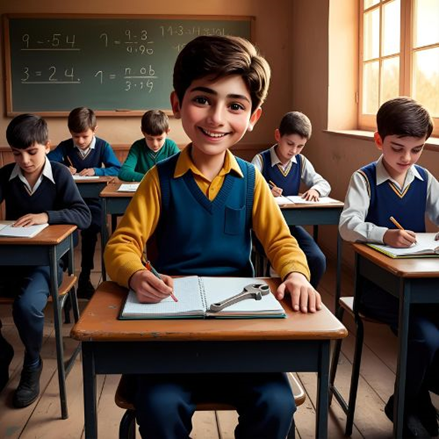
Description
The pseudonym Aladin was chosen because, like the character from the famous tale, this boy is navigating a challenging and unfamiliar world. As a refugee and foreign student, he faces many obstacles—new language, culture, and educational system—that mirror Aladdin’s journey through unknown territories. He shows resilience and adaptability despite hardships such as trauma and social difficulties. The name reflects his struggle for belonging, his resourcefulness, and his hope for a better future
SIGNS OF STUDENT DISENGAGEMENT
General Overview
Aladin is a foreign student with refugee status. His family has lived in Bulgaria for four years. He still cannot speak the local language. He has poor academic performance and difficulties in social relationships with some students. He is not oppositional but does not fully engage in class. His parents don't speak Bulgarian and cannot help him with lessons. His attention is poor
Academic Performance
Aladin has a lot of poor academic performance in all subjects. There is no significant decline in his knowledge, but the material becomes more difficult in the 5th grade. He can hardly read in Bulgarian and cannot read in his native language at all. He often does not have homework. His attention in class is poor. His parents cannot help him due to the language barrier. His parents that it is normal to have low academic performance is normal because of different cultural expectations for children in Bulgarian schools. (In the Arabic school they come from, children do not study much; they play outside, and boys ride motorcycles at a very young age and repair cars.) Teachers suspect he has some specific learning difficulties. The school psychologist has hypothesis that his experience of war has left a psychological imprint, and he suffers from post-traumatic stress. His motivation to study is low.
Behavioral and Social Aspects
Aladin participates in class discussions but sometimes inappropriately, without fully understanding the meaning. He is always happy with individual work. In class, he does not show concern about his performance. His attention is poor, and he has low impulse control—often getting up, laughing, and shouting during lessons.
He is socialable and rarely has conflicts with peers. He wants to spend time with classmates but struggles to hold conversations. His interactions with classmates are mostly during physical activities. During breaks, he tries to make jokes but often invades others’ personal space, which annoys other children. He does not have close friends.
He is adaptable due to frequent changes in his environment.
Emotional and Personal Factors
Aladin has low self-esteem and is very insecure in social settings. He tries to make contact with others and often plays the role of the jester among peers, though he is not satisfied with his friendships.
There are few conflicts with peers, but he is often perceived as annoying.
Learning Style
Aladin needs more visual aids in his education. He attends individual classes and performs better in them. He is interested in practical learning, such as how to repair cars or trucks. He needs more movement incorporated into his studying. Positive feedback is motivating for him. Aladin demonstrates a need for differentiated learning strategies.
Personal Challenges
The family has financial problems. Only the father works. The mother is a housewife and takes care of Aladin and his three siblings. Some parents at the school organized a donation for them.
Aladin’s parents do not assist him with his studies because they do not speak Bulgarian. The mother is not an authority figure for Aladin and cannot make him do his homework.
Aladin enjoys music and is motivated during music classes.
#BBD0E0
»
5
the editor